Table of Contents
Introduction
In today’s globalized economy, companies are increasingly hiring talent across borders. However, expanding into new countries comes with complex legal, tax, and compliance requirements. This is where Employer of Record services play a critical role.
An Employer of Record (EOR) is a third-party organization that legally employs workers on behalf of another company. While the client company manages the employee’s daily tasks and performance, the EOR handles all formal employment responsibilities, including payroll, tax compliance, benefits administration, and adherence to local labour laws.
This model allows businesses to hire internationally without establishing a legal entity in the target country.
What Is an Employer of Record?
An Employer of Record is a legally registered entity in a specific country that becomes the official employer of a worker for legal and administrative purposes. The EOR signs the employment contract with the employee and assumes responsibility for:
- Payroll processing
- Tax withholding and reporting
- Employment contracts
- Benefits administration
- Compliance with local labour laws
- Termination procedures
- Work permits and visa sponsorship (where applicable)
Meanwhile, the client company retains full control over:
- Day-to-day management
- Work assignments
- Performance reviews
- Business operations
This separation allows companies to focus on growth while minimizing legal and compliance risks.
How Employer of Record Services Work
The EOR model operates through a co-employment or direct employment structure:
1. The client identifies a candidate in a foreign country.
2. The EOR hires the employee legally under local labour law.
3. The employee performs work exclusively for the client company.
4. The client pays the EOR, which then processes payroll, taxes, and benefits.
5. The EOR ensures compliance with local employment regulations.
This arrangement enables rapid hiring without the need to set up a subsidiary or branch office.
Key Services Provided by EOR Companies
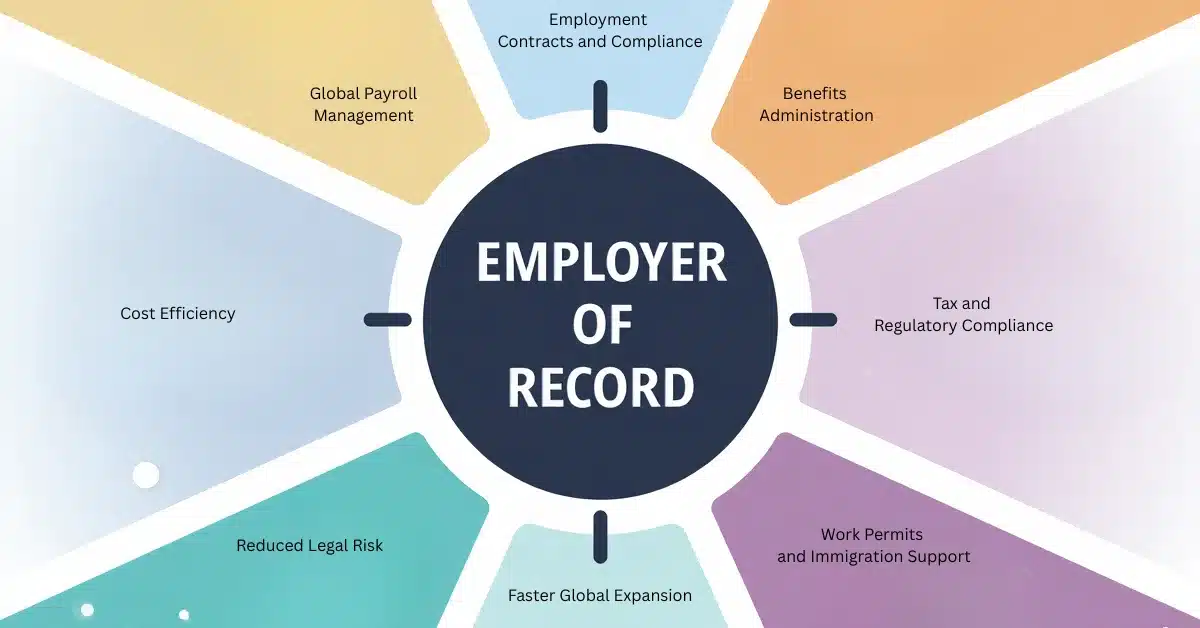
1. Global Payroll Management

EOR providers ensure employees are paid accurately and on time, in compliance with local wage laws and tax regulations. This includes:
- Salary processing
- Tax deductions
- Social security contributions
- Currency management
- Payslip generation
Payroll compliance varies significantly across countries, and mistakes can result in penalties. EOR services mitigate this risk.
2. Employment Contracts and Compliance
Each country has unique labour laws governing employment contracts, notice periods, termination rights, and statutory benefits. An EOR:
- Drafts locally compliant employment agreements
- Ensures adherence to minimum wage laws
- Manages probationary periods
- Handles termination procedures legally
This reduces exposure to wrongful termination claims and regulatory fines.
3. Benefits Administration
EORs manage mandatory and optional employee benefits, such as:
- Health insurance
- Pension contributions
- Paid leave
- Parental leave
- Sick leave
They may also offer competitive benefits packages to help companies attract global talent.
4. Tax and Regulatory Compliance
Compliance is one of the most complex aspects of international hiring. EOR providers:
- Register employees with tax authorities
- Submit payroll taxes
- Ensure adherence to employment standards
- Monitor regulatory changes
This is particularly valuable in countries with strict labour protections.
5. Work Permits and Immigration Support
If a company hires foreign nationals, EORs may assist with:
- Visa applications
- Work permits
- Residency documentation
This simplifies international mobility and relocation processes.
Benefits of Using Employer of Record Services

1. Faster Global Expansion
- Setting up a legal entity in a foreign country can take months and cost thousands of dollars. An EOR enables companies to hire within days or weeks.
2. Reduced Legal Risk
- Local labour laws can be complex and differ widely between countries. An EOR ensures compliance and reduces liability exposure.
3. Cost Efficiency
- Instead of investing in entity formation, legal counsel, and HR infrastructure, companies pay a predictable service fee to the EOR.
4. Administrative Simplicity
- Payroll, tax filings, and HR documentation are centralized and managed externally, freeing internal teams to focus on strategy.
5. Access to Global Talent
- Companies can hire the best candidate regardless of geographic location, supporting remote and distributed work models.
EOR vs. Professional Employer Organization (PEO)
Although often confused, EOR and PEO services differ:
- EOR: Becomes the legal employer and does not require the client to establish a local entity.
- PEO: Operates in a co-employment model but requires the client to have a registered legal entity in that country.
- EOR services are ideal for companies without an established presence in a foreign market.
EOR vs. Independent Contractors
Some companies hire independent contractors instead of using EOR services. However, misclassification risks can arise if a contractor functions like a full-time employee. Consequences may include:
- Back taxes
- Fines and penalties
- Legal disputes
An EOR eliminates classification risk by ensuring proper employment status under local law. Employer of Record Services handle employment contracts professionally.
Industries That Commonly Use EOR Services
EOR solutions are widely adopted across various sectors:
- Technology and SaaS companies
- Startups scaling globally
- Financial services firms
- Consulting organizations
- Manufacturing companies
- Healthcare and life sciences
Remote-first companies particularly benefit from EOR arrangements.
Potential Limitations of EOR Services
While EOR services provide significant advantages, there are considerations:
1. Cost: Service fees may range from a percentage of payroll to a fixed monthly fee per employee.
2. Less Direct HR Control: Some HR policies may be subject to local regulation or EOR frameworks.
3. Long-Term Strategy: For large, permanent operations in one country, establishing a legal entity may eventually be more cost-effective.
Companies should evaluate their expansion plans before selecting an EOR model.
Choosing the Right Employer of Record Provider
When evaluating EOR partners, consider:
- Geographic coverage
- Compliance expertise
- Transparent pricing structure
- Data security standards
- Customer support
- Technology platform usability
- Reputation and track record
A strong EOR provider should offer scalable solutions aligned with your global growth strategy. Employer of Record Services support fast employee onboarding.
The Growing Importance of EOR in Remote Work
The rise of remote work has accelerated demand for EOR services. Businesses are no longer limited to hiring within commuting distance of their offices. Instead, they can build distributed teams across continents.
However, remote hiring introduces complex cross-border employment issues. EOR providers simplify this process by acting as the legal backbone of international workforce management.
As companies compete for global talent, EOR services enable agility, compliance, and operational efficiency.
Understanding the Role of an EOR in Global Hiring
A Employer of Record does much more than pay people. Its scope is broader; it delivers compliant and professional employment infrastructure so that a company can be physically present in a new market and employ people there, before the organization itself forms it’s own entity. This is particularly useful if you are testing the waters, want to start with a few hires or hire specialized personnel before full investment is possible or is intended.
The software development firm in the US, for example, finds an excellent developer in the Germany.
If the tech firm would not decide to create their own legal entity in Germany immediately, the firm can choose an EOR service provider that is legally active in Germany. The EOR can hire the developer in his/her name and handle all payments to the developer and the German authorities. The tech firm can manage the day to day work of the German developer. This allows business growth planning and international hiring to be detached, whilst at the same time offering the capacity to decide whether or not the market is viable in the long term for further investments.
How EOR Services Support Employee Onboarding
Global employee onboarding is definitely more than just an offer of employment. The new hires need contracts that meet regulatory requirements, payment details, benefit descriptions, tax documents, among other documents.
An EOR will be able to facilitate such processes using an optimized framework. Once the client has chosen a candidate, a typical step taken by the EOR is creating the applicable employment documents and obtaining all information required for payroll and compliance.
The new employee then receives data related to pay, benefits, annual leave, payment cycles and other specific clauses about the employment.
An efficient onboarding process is a key factor in increasing employee satisfaction, especially by clearly informing the worker about their working situation right from the start. Also it means fewer work processes for the firms HR department.
A smooth onboarding may be particularly relevant for international firms, as employees can be geographically dispersed in various different regions requiring differing set of employment laws and standards.
EOR Payroll and Currency Management
For example, companies struggle with managing international payrolls when their workers are located in countries that utilize different currencies, tax frameworks, compensation calendars, and statutory withholdings. An EOR can manage the payroll processes to be in line with the worker’s country employment laws.
Many payroll companies and service providers manage everything from gross to net salary calculation, along with the relevant statutory and mandatory deductions, benefits and taxes applicable, based on the jurisdiction and service provider.
Payment of employees in the correct local currency also plays a role, especially for those companies whose finances operate in one currency while their employees receive payments in another currency.
The EOR service provider can help arrange payments along with producing pay stubs for the employee and the business owner.
Managing Employee Benefits Through an EOR
Benefits differ from country to country Depending on the region, an employee benefits package that may be standard elsewhere may not be relevant or legally compliant in a particular country. Working with an EOR can give businesses clear insight into the legally mandated employee benefits and even allow companies to offer benefits to meet local standards such as health coverage, retirement contributions, holiday time, maternity/paternity policies, and other employees programs.
Competing in a fierce international talent market While many employers consider benefits as part of the recruitment process for high-tier international professionals to entice candidates into taking new positions that compete within the local employment market, companies have the responsibility of studying thoroughly any employment benefits package that the EOR includes or to which supplemental fees apply.
EOR Services for Startups
Startups have to execute with a sense of urgency yet have their resources carefully monitored. Hiring abroad can introduce more organizational complexities that may sidetrack the founder and their lean HR teams from developing their products, fundraising, closing clients and growing their customer bases.
Partnering with an EOR can help you begin hiring workers internationally without having to immediately set up extensive international legal and HR operations. For example, a startup’s founding team might wish to bring in 3 developers from 3 separate geographies.
Without utilizing the EOR service model, this will result in establishing three respective legal entities on their behalf in those respective countries, when there may be flexibility using an EOR to legally employ workers without such complexity, while the startup is still exploring if it should become an international business. Once the scale gets bigger, they’d be able to revisit if it continues to be best for them to continue using an EOR or establishing their respective corporate structures.
Conclusion
Employer of Record services has become wholly a strategic tool for modern kind of businesses expediently seeking global expansion without the burden of establishing relevant foreign entities. By handling payroll, compliance, tax obligations, and employment contracts, EOR providers reduce legal risks and administrative complexity.
For start-ups exploring international markets, mid-sized companies scaling operations or enterprises hiring remote teams, EOR solutions offer flexibility and speed. While they may not replace the need for a legal entity in every situation, they provide a powerful pathway to global hiring.
As the world of work continues to evolve, Employer of Record services will remain central to enabling borderless employment and sustainable international growth.