Table of Contents
Sustainable business consulting is a professional service that adeptly helps organizations integrates environmental, social, and economic sustainability into their strategies, operations, and culture. As climate change, resource scarcity, social inequality, and regulatory pressure intensify, businesses are increasingly expected to operate responsibly while remaining competitive.
Sustainable business consultants guide organizations through this transition, helping them create long-term value not only for shareholders, but also for employees, communities, and the planet.
At its core, sustainable business consulting focuses on aligning profitability with purpose. Rather than treating sustainability as a standalone initiative or marketing exercise, consultants embed it into core business decisions such as supply chain design, product development, risk management, and corporate governance. This approach recognizes that sustainability is not a constraint on growth, but a driver of innovation, resilience, and competitive advantage.
Strategy Development
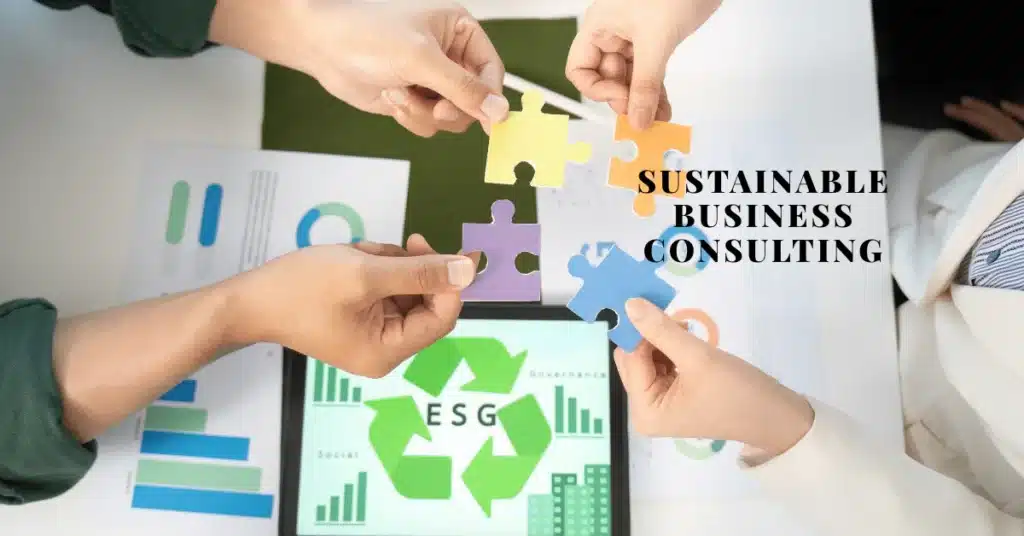
One major area of sustainable business consulting is strategy development. Consultants work with leadership teams to define a sustainability vision that aligns with the organization’s mission and market positioning. This often includes conducting materiality assessments to identify the environmental, social, and governance (ESG) issues most relevant to the business and its stakeholders. By prioritizing what matters most, companies can focus resources on initiatives that deliver both impact and business value. Strategic sustainability plans typically include clear goals, timelines, performance indicators, and accountability structures.
Environmental sustainability is a central pillar of consulting engagements. Consultants help businesses measure and reduce their environmental footprint by analyzing energy use, greenhouse gas emissions, water consumption, waste generation, and resource efficiency. This may involve conducting carbon footprint assessments, setting science-based emissions reduction targets, or transitioning to renewable energy sources. In manufacturing and operations-heavy industries, consultants often redesign processes to improve efficiency, reduce waste, and lower costs through circular economy principles such as reuse, recycling, and product life extension.
Supply Chain Sustainability
Supply chain sustainability is another critical focus area. Many of a company’s environmental and social impacts occur outside its direct operations, particularly in global supply chains. Sustainable business consultants help organizations assess supplier risks, improve transparency, and implement responsible sourcing practices. This can include supplier audits, codes of conduct, traceability systems, and capacity-building programs that support suppliers in generally improving labour conditions, environmental performance, and ethical practices. Strong supply chain sustainability reduces reputational risk and increases resilience to disruptions.
Social sustainability is equally important and encompasses issues such as labor rights, diversity and inclusion, employee wellbeing, community engagement, and human rights. Consultants help organizations evaluate workplace practices, develop inclusive policies, and create cultures that support fairness and opportunity. This may involve pay equity analysis, diversity strategies, health and safety improvements, or employee engagement programs. Externally, consultants wholly support companies in designing community investment initiatives and managing social impacts in regions where they operate.
Ethical Compliance Systems
Governance and ethics form the third pillar of sustainable business consulting. Strong governance ensures that sustainability commitments are credible, measurable, and enforced at the highest levels of the organization. Consultants advise on board oversight of ESG issues, executive compensation linked to sustainability performance, risk management frameworks, and ethical compliance systems. Transparent governance builds trust with investors, regulators, customers, and employees, and helps prevent green washing or superficial sustainability claims.
More importantly reporting and disclosure have become increasingly important as investors, regulators, and customers demand greater transparency. Sustainable business consultants assist organizations in navigating complex reporting frameworks and standards such as GRI, SASB, TCFD, and integrated reporting. They primarily help collect reliable data, develop meaningful metrics, and communicate sustainability performance in a clear and credible way. Effective reporting not only meets compliance requirements but also strengthens stakeholder confidence and supports better internal decision making.
Innovation Aspects
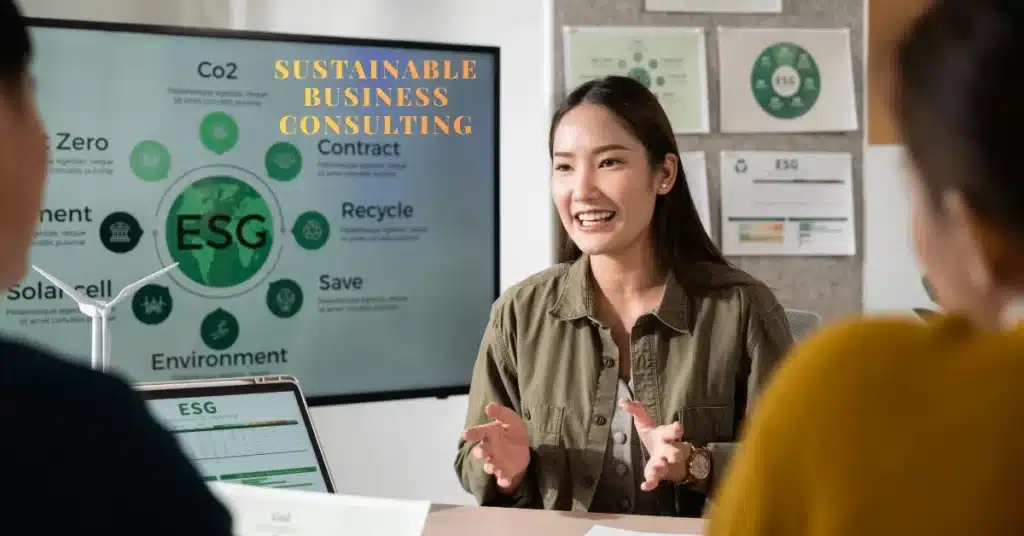
Innovation and product development are powerful levers for sustainability. Consultants help businesses redesign products and services to reduce environmental impact while meeting customer needs. This can include eco-design, sustainable packaging, low-carbon products, or service-based business models that wholly replace ownership with access. By embedding sustainability into innovation processes, companies can differentiate themselves in the market and tap into growing demand for responsible products and services.
Change management and organizational culture are often the most challenging aspects of sustainability transformation. Sustainable business consulting recognizes that lasting change requires people to think and act differently. Consultants support training programs, leadership development, internal communications, and incentive structures that encourage sustainable behaviours across the organization. They actually help break down silos, align departments, and build internal capabilities so that sustainability becomes part of everyday decision-making rather than a top-down directive.
Digital Tools
Technology and data play an increasingly important role in sustainable business consulting. Digital tools enable better measurement, monitoring, and optimization of sustainability performance. Consultants help organizations leverage technologies such as data analytics, artificial intelligence, and blockchain to track emissions, manage supply chains, and improve resource efficiency. Technology-driven insights allow businesses to move from reactive compliance to proactive sustainability leadership.
The business case for sustainable business consulting is strong. Companies that integrate sustainability effectively often experience lower operating costs, improved risk management, stronger brand reputation, and greater customer loyalty. Investors are increasingly favouring companies with strong ESG performance, and employees, especially younger generations, prefer to work for organizations with a clear sense of purpose. Sustainability also enhances long-term resilience by helping businesses anticipate regulatory changes, adapt to resource constraints, and respond to shifting societal expectations.
Powerful Differentiator
Sustainable business consulting is not limited to large corporations. Small and medium-sized enterprises, start-ups, and non-profit organizations also benefit from expert guidance tailored to their scale and resources. Consultants help these organizations prioritize actions, access sustainable finance, and embed responsible practices early in their growth journey. For start-ups in particular, sustainability can be a powerful differentiator and foundation for scalable impact.
Why Sustainable Business Consulting Matters Today
The business world is evolving at an unprecedented pace and sustainability is moving up from a niche issue to a core element of strategic decision-making. The customers are increasingly focusing on how business acquire material for business purpose, manufacturing process, employee treatment and management of environmental influence. Business partners, shareholders, employees, government and public are increasingly monitoring businesses on the sustainability of its actions based on its long-term success in this regard.
Sustainable business consultancy assist organizations to strategically respond to these challenges. Business, instead of individual environmental/social issue, can build a sustainability road-map linking business and profit driven actions.
A comprehensive sustainability strategy aids a company to recognize those opportunities previously missed; such as reducing energy consumption can reduce cost and at the same time transportation costs due to improved supply chain efficiency can lower overall costs through resource optimization and minimized waste; Similarly effective employee engagement leads to higher retention and higher productivity.
Circular Economy Strategies
Traditional businesses operate on the: take-make-dispose model, extract the resources, make products from them, sell the products, and finally, get rid of the waste. Consultancies offering support towards sustainable practices increasingly advise taking inspiration from circular economy business models to keep products and materials in use.
Business consultants can guide organisations to reduce how much material they use and help to keep products in use for longer. Depending on the organisation, this can come in the form of repairing products, upcycling and redesigning products and packaging, take back schemes, rental models and modular, re-purposable product design.
By embracing some or all of the concepts within the circular economy a new market can also be created within your business: rental models, product as a service and repair and maintenance revenue Streams as alternatives to product purchase. For manufacturers this can mean less reliance on raw and finite materials and supply chains that are less fragile.
Sustainable Procurement
Procurement choices can shape a firm’s impact on the environment and society. As sustainable business consultants, we advise procurement departments on how to use criteria such as energy use, responsible sourcing, labor conditions, environmental certificates, waste disposal and the traceability of supply chains in how we conduct risk assessment of potential partners and in establishing our company procedures of procurement procedures. In short, we assist organisations to set up their supplier evaluation processes with sustainability at the forefront of it.
It’s important especially for global players with extensive global networks of partners and suppliers.
Instead of merely removing any potential partners that don’t align with environmental expectations and objectives, organisations could consider a cooperative effort to work with suppliers toward enhancing productivity. This may involve capacity building programmes, audits or coaching to assist improvement.
Sustainable Finance and Investment
Sustainability has started to intersect with and play a role in business finance and investment as well. Sustainable Business consultants can advise businesses on how financial investment decisions, capital allocation, and the environment can work together. For example, sustainable Business consultants may address such areas as: Sustainability financing, Green finance, Investment in energy efficiency, Any and other financing activities associated with promoting socially responsible business practices.
Another useful role of consultants for businesses undertaking a project to enhance sustainability in their organization would be to write the business case analysis for such a sustainable endeavor.
For example, in the installation of energy-efficient appliances you, as business owners, know they cost cash, but ultimately, a business plan may show how much you save in the years ahead. A consultant could project potential costs, benefits, risk assessment, return on investment (ROI). Sustainable investments business is gaining interest because executives only adopt and invest in initiatives where they can comprehend the implications, value, and also impact related to sustainability.
Employee Engagement and Sustainability Culture
The employees themselves contribute immensely to achieving any kind of plan towards sustainable goals. It does not matter how ideal the sustainability objectives of the firm; if the team does not know what their job function towards meeting those plans or does not feel part of it is highly impossible to achieve it. The following can be implemented to assist with employee engagement; Sustainable consultants can assist with building employee engaging activities which put sustainability at people level thereby making it understandable and applicable.
The employee trainings can enlighten how the behavior impact energy consumption, waste generating purchasing processes, commuting habits and proper office culture.
Create the employee based project groups / teams to identify the area for improvement and recruit and motivate for employees for taking care. Incentives can be used to promote positive behaviors but the main aim should not be to ask employees; do sustainable; instead make workplace culture itself sustainable.
Sustainability Audits and Assessments
Often many organizations will carry out an sustainability assessment before developing a strategy of any kind. This helps the organization establish what it is currently doing so that they can see where it can improve. A sustainability audit might look at premises, consumption of energy, purchasing, policy towards employees, supply chain, disposal of waste, governance and its current sustainability activities. Consultants will measure against: standards demanded by industry, regulations governing the country, goals set internally or against a particular sustainability framework.
Leadership can then see which of the required and identified projects to focus resources on depending on its effectiveness. This avoids businesses being overwhelmed trying to achieve to much.
Role of Technology in Sustainability Transformation
Digitalization is becoming intertwined with the concept of sustainability. Businesses can leverage the use of technology to gather data, track performance, analyze data for shortcomings, and automate sustainability processes.
IoT devices can also track energy and water usage in factories and buildings, data analytics can detect unexpected trends in energy and water usage and make predictions for areas to improve, and AI can aid in forecasting, logistics optimization and resource planning.
Centralized sustainability platforms using the cloud may collect data from various departments and facilities providing better integration of sustainability performance to help streamline reporting.
Consultants have a responsibility in organizations to evaluate technology solutions that offer value and not merely adopt any technology that is popular. Technology should contribute to quantifiable business and environmental goals.
Final Thoughts
In conclusion, sustainable business consulting plays a vital role in helping organizations navigate the transition to a more responsible and resilient economy. By integrating environmental stewardship, social responsibility, and strong governance into core business strategies, consultants enable companies to create value that extends beyond short-term profits. As global challenges continue to intensify, sustainable business consulting will remain essential in shaping businesses that are not only successful, but also positive forces for society and the planet.