



Table of Contents
As technology rapidly evolves, businesses increasingly rely on cloud computing to power their operations. At the heart of cloud computing lies its foundation infrastructure. Often referred to as Infrastructure as a Service (IaaS), it forms the backbone that supports cloud-based applications, services, storage, and computing resources. This article of Infrastructure in Cloud Computing explores what infrastructure in cloud computing entails, its components, benefits, challenges, use cases, and leading providers. Startups often Make Infrastructure in cloud computing because it’s flexible and affordable.
What Is Infrastructure in Cloud Computing?
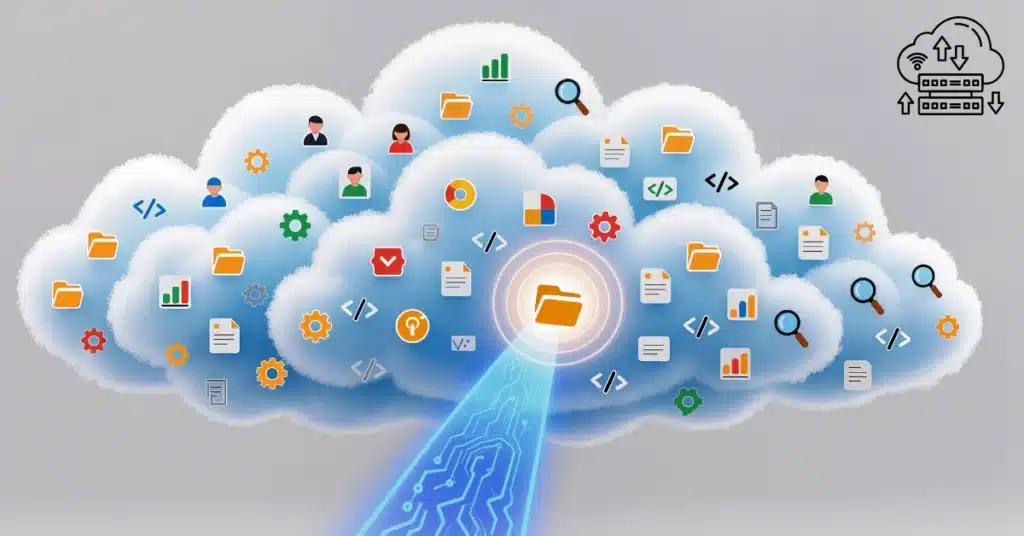
Cloud infrastructure refers to the virtualized hardware and software components delivered over the internet that are essential for cloud computing. It includes physical servers, storage, networking equipment, virtualization software, and management tools all housed in data centers and made accessible via the cloud. You can Make Infrastructure in cloud computing that scales up when your app gets busy.
Cloud infrastructure enables users to access powerful computing resources without having to own or maintain physical hardware.

How Cloud Infrastructure Works
So, how does cloud infrastructure work? It’s essentially a mix of hardware, virtualization software, apps, networking and management interfaces. Although users interact with it using either a web dashboard or a command-line interface, there’s a lot of infrastructure that goes on in the background.
For instance, when you spawn a virtual machine from a cloud provider, your provider will assign it with some of the computing power they have in their data centers and package it as a server for your use. You can then load it with your favorite operating system, install your apps, assign it network settings, and so on, all without touching any actual server hardware.
The level of abstraction in cloud infrastructure is one of the primary reasons it’s gained so much traction in the business world. Companies can leverage infrastructure without actually needing to invest in building data centers, purchasing physical servers, or maintaining a team dedicated to infrastructure management.
Key Components of Cloud Infrastructure
1. Compute Power
- Provided through virtual machines (VMs) or containers.
- Allows running applications, hosting websites, and managing workloads.
- Offers scalable options to match business needs.
2. Storage
- Offers scalable data storage solutions (e.g., object, block, and file storage).
- Examples include Amazon S3, Google Cloud Storage, and Azure Blob Storage.
3. Networking
- Provides connectivity between cloud services and external systems.
- Includes load balancers, firewalls, VPNs, IP addresses, and content delivery networks (CDNs).
4. Virtualization
- Enables physical servers to be divided into multiple isolated environments.
- Hypervisors like VMware, KVM, and Xen create and manage VMs.
5. Data Centers
- Physical facilities that house servers, storage, and networking equipment.
- Operated by cloud providers across global locations for redundancy and performance.
6. Management Tools
- Platforms for automating, monitoring, and orchestrating cloud resources.
- Tools include dashboards, APIs, auto-scaling, billing, and analytics systems.
Infrastructure as a Service (IaaS)
IaaS is a cloud service model where users rent computing infrastructure over the internet. It provides maximum flexibility and control over the underlying infrastructure compared to Platform as a Service (PaaS) or Software as a Service (SaaS). You can Make Infrastructure in cloud computing without buying any physical servers.
Examples of IaaS Providers:
- Amazon Web Services (AWS) EC2
- Microsoft Azure Virtual Machines
- Google Compute Engine (GCE)
- IBM Cloud Infrastructure
- Oracle Cloud Infrastructure (OCI)
With IaaS, organizations can:
- Deploy and manage VMs
- Store and back up data
- Create complex virtual networks
- Scale infrastructure based on demand
Benefits of Cloud Infrastructure
1. Scalability
- Easily scale resources up or down based on usage.
- Auto-scaling helps handle traffic spikes without performance loss.
2. Cost Efficiency
- Pay-as-you-go or subscription pricing models reduce capital expenditure.
- Eliminates the need for purchasing and maintaining physical servers.
3. Flexibility
- Access infrastructure anytime, from anywhere.
- Supports hybrid and multi-cloud strategies.
4. Speed and Performance
- Cloud providers offer high-performance computing with minimal latency.
- Global data centers enable regional availability.
5. Security
- Advanced security protocols, encryption, and compliance support.
- Features like IAM (Identity and Access Management), firewalls, and DDoS protection.
6. Disaster Recovery
- Built-in redundancy and backup options reduce risk of data loss.
- Enables quick recovery and business continuity.
7. Innovation Enablement
- Easily test, deploy, and scale new applications or services.
- Faster go-to-market capabilities.
Challenges of Cloud Infrastructure
1. Data Privacy and Compliance
- Sensitive data stored on third-party servers raises concerns.
- Organizations must comply with regulations like GDPR, HIPAA, etc.
2. Downtime Risks
- Outages in cloud services can affect business continuity.
- Though rare, downtime can lead to revenue loss.
3. Security Threats
- Cloud environments can be targets for cyberattacks.
- Requires robust access controls and monitoring.
4. Vendor Lock-In
- Difficulty migrating workloads between providers due to compatibility or cost.
5. Cost Management
- Uncontrolled scaling or idle resources may lead to unexpected costs.
- Requires proper monitoring and budgeting.
Cloud Deployment Models
1. Public Cloud
- Infrastructure is owned and operated by third-party providers.
- Examples: AWS, Azure, Google Cloud.
- Shared infrastructure but isolated user environments.
2. Private Cloud
- Infrastructure is used exclusively by one organization.
- Can be hosted on-premises or by a third party.
3. Hybrid Cloud
- Combination of public and private clouds.
- Allows data and applications to move between environments.
4. Multi-Cloud
- Use of multiple cloud providers to avoid dependency on a single vendor.
- Enhances flexibility and reduces risk.
Use Cases of Cloud Infrastructure
- Web Hosting: Host websites with scalable VMs and global CDN support.
- Software Development: Run dev/test environments and CI/CD pipelines.
- Big Data and Analytics: Process and store massive datasets using tools like Hadoop and Spark.
- Machine Learning: Train and deploy ML models using GPU-optimized infrastructure.
- Disaster Recovery: Ensure data backup and recovery during system failures.
- E-commerce Platforms: Scale resources during peak shopping times.
- Gaming: Support multiplayer online games with low latency infrastructure.
Leading Cloud Infrastructure Providers
1. Amazon Web Services (AWS)
- Market leader with the broadest range of services.
- Offers Elastic Compute Cloud (EC2), S3, VPC, RDS, and more.
2. Microsoft Azure
- Strong integration with Windows and enterprise tools.
- Offers Azure Virtual Machines, Blob Storage, and Azure Networking.
3. Google Cloud Platform (GCP)
- Known for AI, machine learning, and data analytics tools.
- Offers Compute Engine, Cloud Storage, and Cloud VPC.
4. IBM Cloud
- Focuses on hybrid cloud and AI integration with Watson.
- Offers bare metal and virtual servers.
5. Oracle Cloud Infrastructure
- Optimized for Oracle applications and databases.
- Offers strong performance for enterprise workloads.
Future of Cloud Infrastructure
- Edge Computing: Bringing computing closer to the data source to reduce latency.
- Serverless Infrastructure: Using functions that scale automatically without managing servers.
- AI Integration: Automating infrastructure management with machine learning.
- Green Cloud: Energy-efficient data centers and carbon-neutral initiatives.
- 5G & IoT: Supporting new workloads driven by real-time, connected devices.
Virtual Machines vs Containers
Virtual machines and containers-the most frequent ways to run apps in cloud infrastructure, work in different ways. A virtual machine comes with a full operating system, and they exist at a completely virtualized set of hardware. They offers you great isolation as you’re operating your entire computer, nevertheless they’re a tiny larger when the subject comes down to assets.
Containers tend to be much simpler considering that they share your guest machine’s operating system’s kernel whileisolating their own personal program plus associated files or sources required to operate.
Containers aren’t beneficial not only for newer functions in microservices, but in add.
Role of Networking in Cloud Infrastructure
Networking is essential to cloud infrastructure since applications, databases, user, and service need to intercommunicate with each other. The virtual networking system is offered by cloud providers enabling organizations to build private isolated network, define IPs, and establish route. A virtual private network, firewall, load balancer and security groups are applied to control traffic between different resources.
A good networking architecture not only enhances application performance but also decreases public internet exposure.
For large organizations, networking becomes a more critical point with cloud infrastructure distributed over different regions, data centers, business applications and business outside systems.
Cloud Infrastructure and Automation
One essential part of this new style ofcloud infrastructure managementis automation. No longer do you need to configure servers and services manually- instead you simply automate the provision of your infrastructure. We call Infrastructure as Code “IaC” – essentially we can represent infrastructure configurations as either a program or a declarative description.
By using tools such as Terraform, or by leveraging the various built-in deployment capabilities of cloud services.
Automation also simplifies scaling your production for those in growth mode, it becomes increasingly complex and error-prone to expand out the test, staging, and eventually the production environment if this is done manually.
Infrastructure as Code
It can be handy if your organization operates in multiple cloud environments, said the company. The practice can eliminate the need for each bit of configuration to be documented and allows teams to store their infrastructure definitions right beside the app, under version control. As such, infrastructure config changes can be reviewed like application code, by anyone on the team.
And If a piece of infrastructure config causes problems, they’d be able to figure out when it changed and revert it, according to the firm.
That kind of thing really shines in an intricate environment with countless databases, servers, firewalls, networks and security policies.
Cloud Infrastructure Monitoring
Monitoring is crucial to ensuring reliability in your cloud infrastructure. You should monitor how your systems are using CPU and memory, storage space, network traffic and application usage, all while ensuring their uptime.
Cloud monitoring can allow you to gather metrics on all of these and alert you when the condition of your systems reaches certain thresholds. You could set an alert when your CPU usage exceeds a certain level for a set amount of time.
Monitoring enables IT professionals to identify problems in your systems before they begin to impact users, whilst also enabling you to monitor how your system is performing to find where to optimize your infrastructure, and manage costs.
Cloud Infrastructure Security Best Practices
Security in the Design Process Always put the security of your cloud infrastructure in mind as you approach design from the out set. Employ strong credentials, role based permissions, encryption, network isolation, and perform round theclock monitoring as necessary.
Always employ least privilege Organizations should give users and or applications only the permission they absolutely need, so they can do their job, nothing more to diminish the impact of stolen credentials, and/or hacked cloud credentials.
Rotate all cloud user access permissions Organizations need to actively look at their users, and who should have what access.
You wouldn’t keep granting the person who moved to an entirely new role, or worse, who resigned access would you? I guess not. But when was the last time you truly audited permissions and revoked access from former or moved staff? Probably quite while ago.
Conclusion on Infrastructure in cloud computing
Infrastructure in cloud computing is the foundation that enables innovation, flexibility, and growth in the digital era. From small startups to global enterprises, cloud infrastructure empowers organizations to deploy applications quickly, scale effortlessly, and manage resources efficiently. Students can Make Infrastructure in cloud computing for free using education credits. By understanding its components, benefits, and challenges, businesses can make informed decisions about cloud adoption and position themselves for future success. When you Make Infrastructure in cloud computing, you only pay for what you use.